Just Mercy: Mockingbird Players
Just Mercy: Mockingbird Players
Stevenson, B. (2014). Just Mercy. New York: One World Publishing. Pages 19-35.

Harper Lee's To Kill a Mockingbird and Just Mercy by Bryan Stevenson are as interesting in how they're similar as how they're different. They're about structural racism in South Alabama; they're about the attorneys moved to action in the name of those marginalized by those holding power; they're about Black men who are wrongfully accused in violence against white women. Meanwhile, we see very different attorneys in Atticus Finch and Bryan Stevenson. There is a lens shift, as well: Mockingbird is written from a distinctly white lens, and Tom Robinson's ultimate demise is secondary to the fact that Atticus Finch is a hero because he tried. Conversely, Stevenson's lens in Mercy centers on the Black experience -- as an attorney, as a convict, and as a member of a larger community in the South.

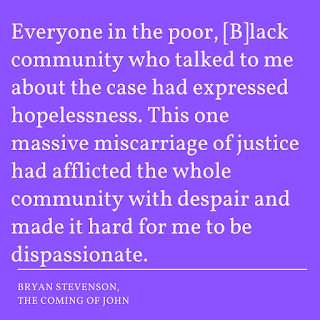
Stevenson draws these parallels into sharp contrast in the chapter Mockingbird Players, titled after the internationally recognized theatre troupe formed in Monroe County. I found this incredibly interesting, particularly as I've grown up here in Alabama (albeit, in Birmingham) and have been acutely aware of the role Lee's work has played on the literary world and in discussions involving race among white Southern people. However, as Stevenson pointed out (see pull quote), the moral of Lee's story have largely fallen to ears that have been unwilling to hear her message. Structural racism had not remotely corrected itself in the 40 years between Mockingbird's setting in the 1930s and the Walter McMillian's trial in the 1980s.
It continues to be a human rights crisis now, in 2020 -- nearly 100 years later.
However, I found that the literary comparisons in this chapter did not end there. As I read McMillian's story with Karen Kelly, it occurred to me that there were also incredible parallels to Amiri Baraka's The Dutchman. While McMillian does not demonstrate Baraka's vision of a modern Black Man in Clay, his developing flirtation with Karen Kelly is reflective of the increasing attentions of the dangerous Lula. It wasn't Kelly herself that implicated McMillian in the murders of Rhonda Morrison and Vickie Lynn Pittman, but it didn't have to be for the parallel to work: Lula is not simply a capricious white woman objectifying a Black man. Baraka wrote her to reflect white America and its need to objectify and abuse Black bodies in order to satisfy the white community's continual grasp for power.
For McMillian, this meant pinning the murder of two white women on a man who had never set eyes on either of them, because the white community had become restless in their pursuit of justice.
I'm interested to continue reading!

Comments
Post a Comment