Just Mercy: Of the Coming of John
Just Mercy: Of the Coming of John
Stevenson, B. (2014). Just Mercy. New York: One World Publishing. Pages 92-114.

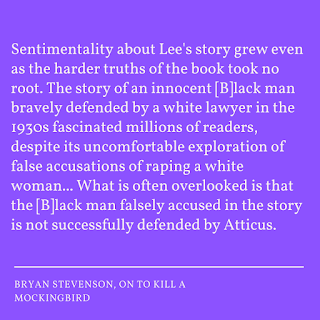
In my last blog post, I draw lines between the narratives in To Kill a Mockingbird and Just Mercy. In the chapter 'Mockingbird Players', Stevenson establishes himself as an esteemed attorney in his own right -- he isn't 'a real Atticus Finch', or 'the Black Atticus Finch', he's Bryan Stevenson, JD. We see him face systemic racism in his own way as he grapples with the Honorable Robert E. Lee Key over the phone, a man who is convinced of McMillian's guilt in spite of non-existent evidence and a swathe of evidence that actually suggests the contrary.
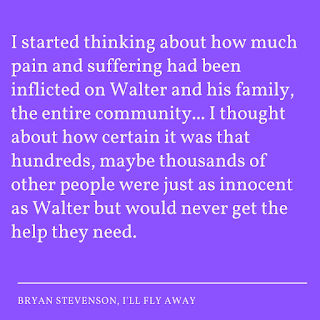
In the chapter 'Of the Coming of John', we diverge from Harper Lee's white-centric lens again, this time in the focus on McMillian's extended family. We don't know a whole lot about the fictional Tom Robinson's family, aside from the fact that he has one, and it's easy for a reader (particularly, a white one) to focus on the drama of the Finches, Boo Radley, and the behavior of Maycomb's townspeople. Without this focus on Tom Robinson's family, we don't consider the implications of his plight:
What happens to his wife and children?
Where is his mother? Does he have people who love him?
Stevenson answers this question as he gently turns our attention to the outskirts of Monroeville, just past the row of liquor stores on the Conecuh/Monroe county line. We hear, in the words of McMillian's family themselves, exactly how his people are faring: It's been eighteen months since his detainment, and his wife has been working grueling shifts at the factory to support their family. As so many of the families victimized by the criminal justice system, Minnie has been left with the task of keeping the dreams of her family alive -- The McMillians have a daughter in college. The system might be wrestling Walter's life from his hands, but they won't let it take the livelihood of their young daughter, too.
Keeping her job at the factory does not end with sustaining her children's physical meeds.
Soon after, we are introduced to Walter McMillian's extended family, all pressed together in a small trailer in pursuit of answers regarding Walter's case. What we know about Walter is that he is part of a large network of family and friends who are all experiencing their own trauma as they have witnessed the events of his sentencing unfold.

There are two things of importance to take away from this chapter:
1) The McMillians of Monroeville are not an anomaly. People do not exist in a vacuum. Even if an individual has broken relationships with their families (as people often do), they still have families who love them. They have friends who care about them, and acquaintances who care about them, and strangers who care about them. The systemic racism present in criminal justice does not simply victimize the individuals ensnared in the system, it violates each individual's entire family network.
2) According to the Equal Justice Initiative website, Alabama sends more people to death per capita than any other state with a rate of .956 percent. Meanwhile, the Death Penalty Information Center shares that as of April of 2020, 87 of the 173 inmates on death row -- roughly 50% -- are Black.
As an educator, it is clear to me that dismantling the school-to-prison pipeline is a matter of life or death, particularly for Black students in Alabama and especially for those students who live in the Southernmost counties of Alabama: 1/3 of all people on death row hail from Houston, Etowah, and Mobile counties, in spite of only being 13% of the state's population (www.eji.org).
Comments
Post a Comment